
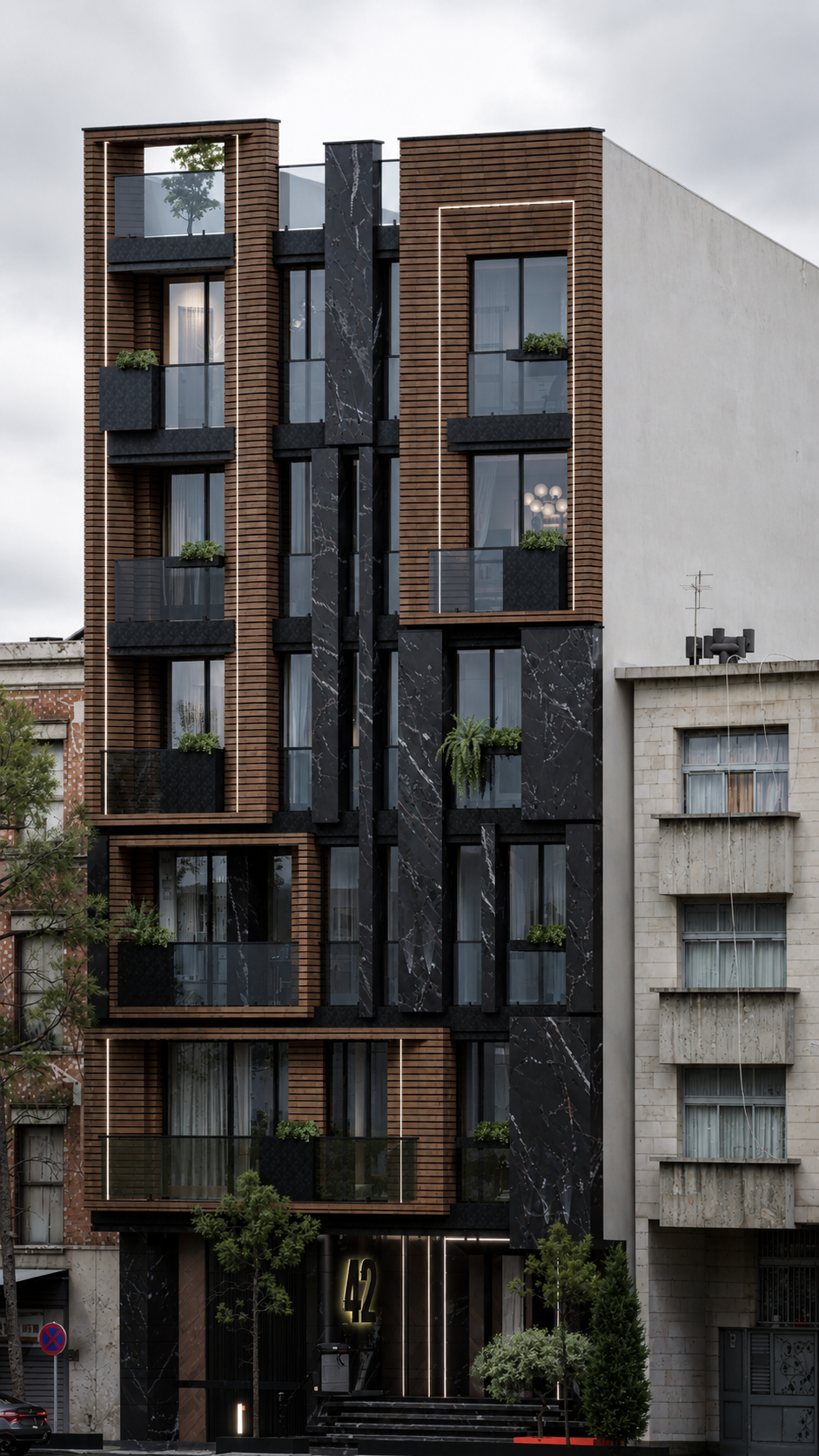
Clarify the facade hierarchy
Before rendering detail, identify the primary mass, openings, entrances, structural rhythm and the elements that create depth. The image should help the viewer understand how these parts relate.
A facade becomes legible when the main architectural move reads before the surface detail.
Contrast can come from depth, shadow, material change or repetition. Not every component needs equal visual emphasis.
Protect proportion with the camera
A frontal view is useful for reading rhythm and elevation, while an oblique view can explain depth and the relationship between faces. Camera height should feel intentional and verticals should be controlled so the building does not appear accidentally distorted.
The amount of street and neighboring context also changes the message: a close view emphasizes detail; a wider view explains scale and urban relationship.
Use daylight to describe form
Light direction should reveal recesses, frames and material transitions. Flat light may hide the depth of an elevation, while excessively dramatic light can obscure the actual design.
Time of day should be chosen for the design rather than for atmosphere alone. The goal is to make important surfaces readable and shadows informative.
Make materials read at the right scale
Joint spacing, panel size, texture scale, reflectance and edge definition all influence credibility. Material difference should remain visible without turning the facade into a collection of unrelated textures.
References should communicate both the intended product and its architectural application. A close material sample alone may not explain how it behaves across a full elevation.
Give context a clear role
Landscape, neighboring buildings, vehicles and people establish location and scale. They should support the building's identity, not create visual noise. Context detail can be reduced where it is not central to the story.
For a more complete commission, connect facade views to relevant plans, detail images or interior moments so the project reads as one system.
Explore the Zhick Facade project as a related case study.
Explore exterior CGI ↗